The River Cam - a guide to the Backs, the bridges and Grantchester
Two rivers in one: the college Backs and the quiet upper river to Grantchester.
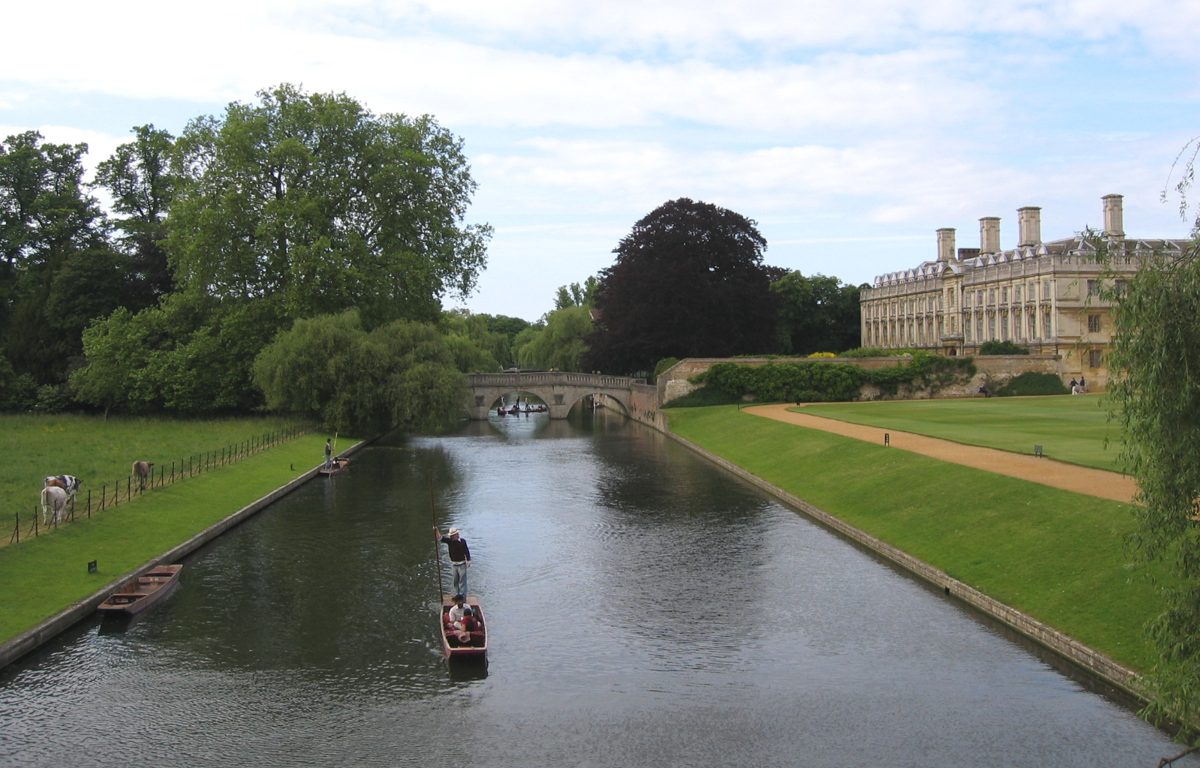
The River Cam in Cambridge has two distinct characters: the college stretch beneath the Backs and famous bridges, and the upper river through meadows and villages. This guide covers six named places, corrects the Newton myth about the Mathematical Bridge, and explains how the two stretches differ, without prices, operators or timings.
The Backs
The Backs is the stretch of river behind several Cambridge colleges, where the water passes lawns, bridges and college buildings in close succession. It is the most photographed part of the Cam, especially where King's College Chapel, Clare College and Trinity College face the river. From public paths and bridges, visitors can see the college backs, but access to college grounds varies by institution and season. The Backs are best understood as a landscape of colleges, bridges and river together, not as a single park.
Mathematical Bridge at Queens' College
The Mathematical Bridge is the wooden footbridge at Queens' College that crosses the Cam between two parts of the college. It is famous for a false story: that Isaac Newton built it without nails and that later students took it apart and could not reassemble it. Newton died in 1727, while the first version of this bridge was built in 1749, so he could not have designed or built it. The bridge is a real wooden structure with visible joints and bolts, and its appeal comes from geometry and engineering rather than from a Newton legend.
Bridge of Sighs at St John's College
The Bridge of Sighs at St John's College is a covered bridge over the Cam, linking parts of the college. It is often compared with the Bridge of Sighs in Venice, but it is not a copy and has its own setting within St John's. Its name and enclosed form make it one of the most recognisable bridges on the college stretch. As with other college bridges, views depend on where the public can stand, and college access rules apply.
The Mill Pond
The Mill Pond is a widened, slower pool on the River Cam near the city centre. It acts as a natural turning and meeting point, with a more open feel than the narrow college channels. The pool is associated with the old mill site and with the transition between the denser college river and the broader water beyond. It is a useful landmark for orienting yourself on the river.
Jesus Green
Jesus Green is a large open riverside space north of the city centre, beside the Cam. It offers broad paths, grass, and long views along the water, with a different atmosphere from the tight college stretch. The area is used for walking, cycling and informal riverside leisure. It is one of the main public green spaces on the lower river and connects easily with other central Cambridge routes.
Grantchester Meadows
Grantchester Meadows lie along the upper River Cam, south-west of Cambridge, where the river opens into grassland and a quieter rural setting. The meadows are strongly associated with Cambridge literary culture, including Rupert Brooke's poem "The Old Vicarage, Grantchester". The upper river here feels slower and less formal than the college stretch, with fewer bridges and more open sky. It is a classic walking and punting destination for those who want the river outside the city centre.
College stretch and upper river
The college stretch runs through central Cambridge, where the Cam is narrow, bridge-filled and closely watched by college buildings. It is the part of the river most tied to tourism, punting and college architecture. The upper river, by contrast, runs towards Grantchester and beyond, with wider water, meadows and a less built-up bank. The practical difference is simple: the college stretch is dense and historic, while the upper river is open and rural. A day on the Cam can include both, but they feel like different rivers.
What to see on the river
The Backs, behind King's, Clare and Trinity, where college lawns meet the water. The Mathematical Bridge at Queens' College, with its visible joints and bolts. The covered Bridge of Sighs at St John's College, often compared with Venice but not a copy. The Mill Pond, a widened pool near the city centre and a natural turning point. Jesus Green, a broad riverside park north of the centre with long views along the Cam. Grantchester Meadows, an open upper-river landscape south-west of Cambridge.
Frequently asked questions
Is the Mathematical Bridge really connected to Newton?
No. The popular claim that Newton built the Mathematical Bridge without nails is a myth. Newton died in 1727, and the first version of the bridge dates from 1749. The bridge is a real Queens' College footbridge, but its history is separate from Newton.
What is the difference between the Backs and Grantchester Meadows?
The Backs is the central college-side stretch of river behind Cambridge colleges, with bridges and formal architecture. Grantchester Meadows is an upper-river landscape of grassland and open water south-west of the city. One is urban and collegiate; the other is rural and meadowed.
Can I see all six places in one walk?
Yes, in principle, because they lie along or near the same river corridor. The Backs, Mathematical Bridge, Bridge of Sighs, Mill Pond and Jesus Green are in or near central Cambridge, while Grantchester Meadows requires a longer walk or punt upstream. Plan for distance and river conditions rather than assuming one short loop.
Why does the college stretch feel so different from the upper river?
The college stretch is hemmed in by buildings, bridges and college walls, so the water feels like a corridor. The upper river opens into meadows and wider skies, so it reads as landscape rather than architecture. Punting happens on both, but the pace and the view change sharply once you leave the centre.
Are the Backs a public park?
Not exactly. The Backs are the riverside grounds behind several colleges, and public access depends on paths, bridges and college rules. You can see much of the scenery from public viewpoints, but entering college grounds is not automatic. Treat the Backs as a shared landscape rather than a single open park.
Is the Bridge of Sighs at St John's a copy of the one in Venice?
No. It is a covered bridge in its own right, with its own setting and proportions. The Venetian name is a comparison, not a description of origin. The Cambridge bridge is best appreciated on its own terms, as part of St John's College.
This is an independent member's guide compiled by Cambridge Society. We are not affiliated with the venues and institutions mentioned; opening arrangements and programmes change - always confirm details on the official websites before making plans.
← Back to Guides